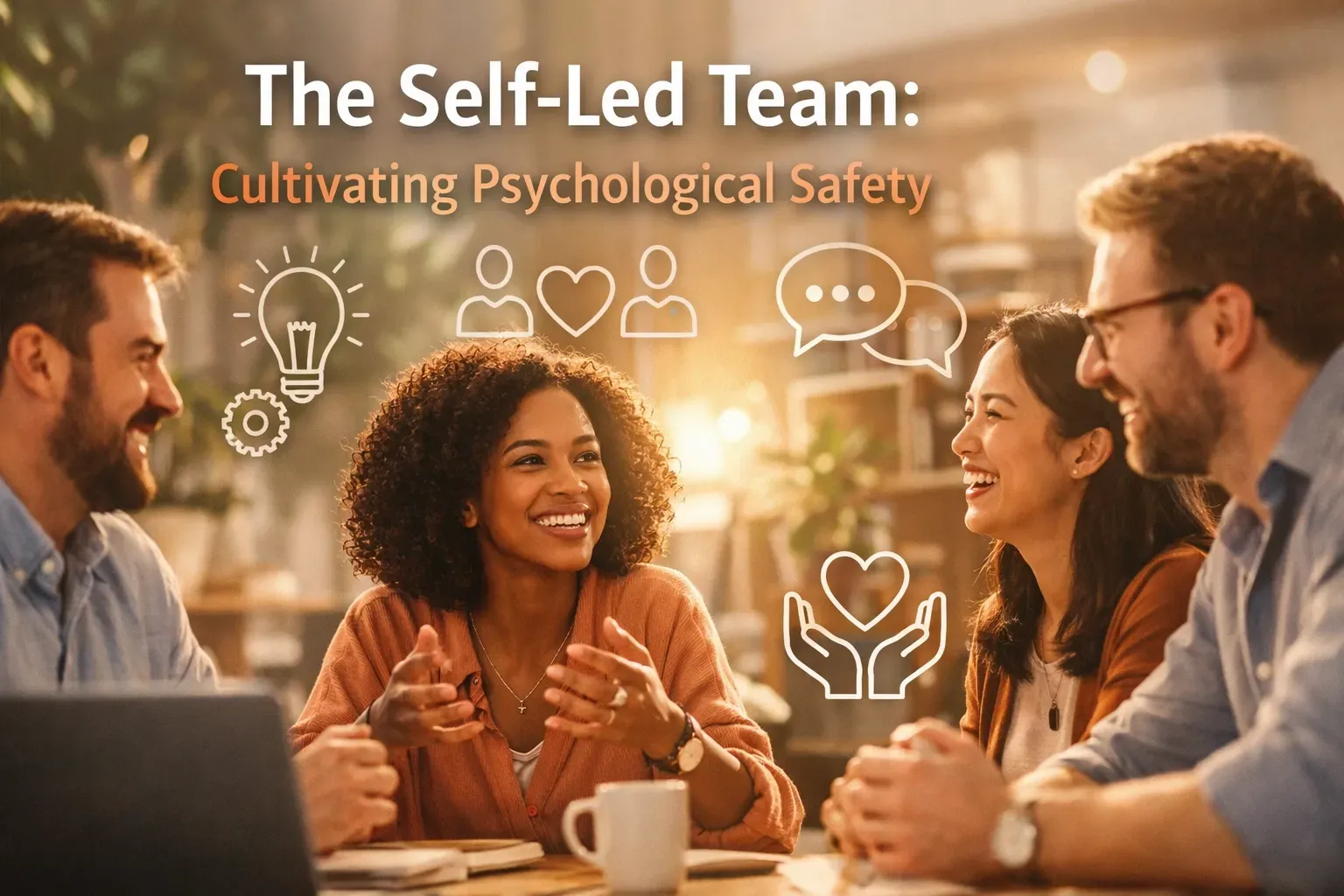
The Self-Led Team: Creating Psychological Safety
"True safety isn't the absence of conflict. It is the presence of the Self, holding space for every voice to be heard without fear."
Imagine walking into your workspace, whether it’s a sunlit office or a digital gallery of faces on a screen, and feeling an immediate sense of expansion. You aren't bracing for criticism, and you aren't rehearsing your defense for a mistake made yesterday. Instead, you feel a quiet confidence. You feel safe to be curious, safe to be wrong, and safe to be entirely yourself. This is the reality of a Self-led team.
At Ananda Experience, I believe that the most innovative and resilient teams are those that understand the internal architecture of the human mind. By applying the principles of Internal Family Systems (IFS), we can move beyond traditional management and into a realm of deep, psychological safety. This is where you and your coworkers stop reacting from fear-based parts and start contributing from your core, creative Self.
What is a Self-led team?
In the world of Internal Family Systems (IFS) developed by Dr. Richard C. Schwartz, we understand that the human psyche is made up of different parts like a family living inside you. Some parts are ambitious and driven, others are cautious and protective, and some carry the weight of past mistakes.
When a team lacks psychological safety, it is usually because the protector parts of its members are running the show. These parts might use silence, aggression, or perfectionism to keep the person safe from perceived threats. A Self-led team is one where individuals have learned to "unblend" from these reactive parts and lead from their Self. The Self is the seat of consciousness, it is inherently calm, curious, and compassionate. When a team is Self-led, the collective energy shifts from self-protection to shared creation.

The foundation of psychological safety
Psychological safety is the shared belief that you will not be punished or humiliated for speaking up with ideas, questions, concerns, or mistakes. While it sounds simple, it requires a profound level of
emotional intelligence
to maintain. Based on current research, a psychologically safe environment consists of four foundational pillars:
- Willingness to help: You feel that your colleagues are genuinely invested in your success, and asking for help is seen as a sign of strength, not a lack of competence.
- Inclusion and diversity: You know that your unique perspective rooted in your specific life experience is not just tolerated but actively sought after.
- Attitude toward risk and failure: Mistakes are treated as data points or learning opportunities rather than reasons for shame.
- Open conversation: Hard truths are spoken with kindness, and there is space for candid, honest dialogue.
When these pillars are in place, your team can move from a state of survival to a state of thriving.
The art of unblending from fear
The biggest obstacle to safety in any group is blending. Blending happens when a protective part of you takes over your seat of consciousness. For example, if a manager gives you constructive feedback, a perfectionist part might blend with you. Suddenly, you feel a rush of heat, your heart races, and you become defensive. In that moment, you aren't you, you are the perfectionist part of you trying to survive a perceived attack.
Unblending is the process of gently asking that part to step back so you can return to your Self. Here is how you can practice this in a team setting:
- Notice the sensation: When you feel a trigger during a meeting, notice where it lives in your body. Is it a tightness in your chest? A knot in your stomach?
- Acknowledge the part: Silently say to yourself, "I see a part of me is feeling defensive right now." This simple act of naming creates a small gap between you and the emotion.
- Extend curiosity: Instead of pushing the feeling away, ask that part, "What are you afraid will happen if you don't defend me right now?"
- Breathe into the Self: Take a deep breath and gently bring your attention back to the present moment. From this place of Self, you can respond with clarity rather than reacting from fear.

Practical steps to create psychological safety
Building a Self-led team is a journey, not a destination. It requires patience as a conscious practice. Here are some simple ways you can begin to foster this culture in your own team:
- Model vulnerability first: As a founder, I often share my own parts with my team. I might say, "A part of me is feeling a bit anxious about this launch, and it’s making me want to micromanage. I’m working on unblending from that." When you do this, you give everyone else permission to be human.
- The parts check-in: Start your meetings by asking everyone to share which part of them is most present today. Someone might say, "My overwhelmed part' is here," while another says, "My excited part is leading." This externalizes the feelings and reduces shame.
- Respond constructively to mistakes: When a mistake happens, focus on the process rather than the person. Ask, "What part of our system allowed this to happen?" This keeps people from going into a shame-spiral, which is the death of creativity.
- Practice anxiety parties: This is a wonderful exercise where team members list their current worries or worst-case scenarios on a shared board. You then rank them together. It normalizes honesty and helps the team realize they aren't alone in their fears.
- Solicit group input: Instead of putting one person on the hot seat, ask for team-wide reflections. This distributes the weight of responsibility and encourages experimentation.
Embracing the wisdom of the whole
When we cultivate psychological safety through the lens of IFS, we aren't just making work nicer. We are unlocking the full potential of the human spirit. We are moving away from the rigid structures of the past and toward a more fluid, organic way of working. Just as water flows around obstacles and air supports all life, a Self-led team adapts and thrives because its members aren't spending all their energy on internal defense. They are free to use that energy for innovation, connection, and joy.
Remember to be gentle with yourself as you implement these changes. Your own protective parts might feel skeptical or worried about losing control. That is okay. Acknowledge those parts, thank them for trying to keep you safe, and invite them to see the benefits of a more connected relationship with your team.

Your Journey Toward Self-Leadership
The path to a Self-led team begins with your own inner work. As you become more attuned to your own internal family, you naturally become a Self-led presence that others can feel. You become the anchor in the storm, the one who stays curious when others get angry, and the one who offers compassion when others offer judgment. You have the power to transform your workplace into a sanctuary of creativity and safety. It starts with one breath, one unblending, and one courageous conversation.
If you’re ready to dive deeper into this transformative way of leading, I invite you to read more about my journey and how we can work together to build a healthy culture. The world needs your core, creative Self. Your team is waiting for it. Let's begin.
Articles