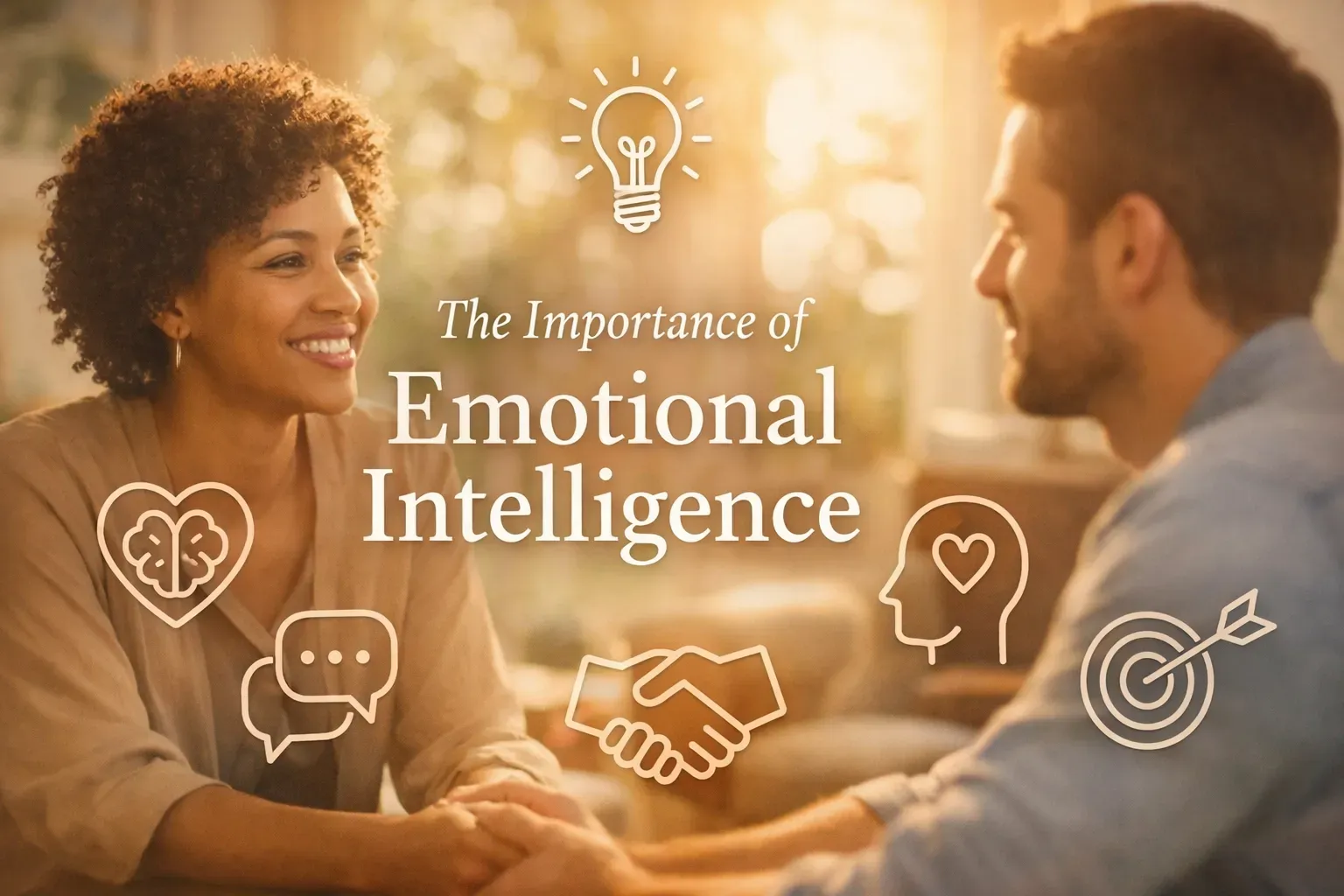
The Importance of Emotional Intelligence
"Emotional intelligence is the key that unlocks the door to understanding ourselves and building meaningful connections with others."
For a long time, we were told that IQ was the ultimate predictor of success. We were taught to stack our resumes with technical skills, certifications, and high-level expertise. But if you’ve ever sat in a meeting room where a brilliant executive lost their cool, or if you’ve felt your own anxiety skyrocket during a simple performance review, you know that technical skill is only half the story.
The quality that truly sets you apart, both in your living room and the corner office, is Emotional Intelligence (EI).
At its core, emotional intelligence is the ability to recognize, understand, and manage your own emotions while effectively empathizing with and relating to others. But here at Ananda Experience, I look at EI through a slightly different lens. I see it as the ultimate expression of Self-leadership. When you have high EI, you aren't just managing feelings, you are leading the different parts"of your internal system with clarity, compassion, and courage.
Whether you are navigating a massive career transition or trying to help your team hit a quarterly goal without burning out, emotional intelligence is the foundation that keeps the structure from collapsing.
The IFS perspective
In the world of Internal Family Systems (IFS), we understand that our minds are made up of different parts, like the inner critic, the people-pleaser, or the high achiever. Traditional emotional intelligence often tells us to control these emotions. But through IFS-informed coaching, we learn to lead them.
Emotional intelligence is essentially the capacity to remain in your Self, that calm, curious core of who you are, even when your parts are feeling reactive.
- Self-awareness becomes the ability to notice when a part is blending with you (like when a protective part of you gets defensive during a meeting).
- Self-regulation becomes the process of unblending, or gently asking that reactive part to step back so your wisest Self can take the lead.
- Empathy becomes
Self-to-Self connection, where you see beyond someone else's reactive behavior and connect with their core humanity.

Why Emotional Intelligence is your greatest asset
Let’s be real. The modern workplace is a pressure cooker. Between global shifts and personal transitions, the old way of pushing through is failing. Here is why prioritizing your internal landscape is the most practical business move you can make:
1. Enhanced self-awareness and personal growth
When you commit to 1:1 coaching, you start to develop a deep understanding of your emotional triggers. You stop wondering why you always do that and start understanding the parts of you that are trying to keep you safe. This self-awareness builds a grounded confidence that doesn't rely on external validation. It allows you to make conscious choices aligned with your values rather than reacting from old wounds or stress.
2. Resilience in the face of conflict
Conflicts are inevitable, but they don't have to be destructive. Emotionally intelligent leaders don't see conflict as a threat; they see it as a parts mismatch. By practicing active listening and maintaining a Self-led presence, you can navigate disagreements without burning bridges. You become the person in the room who can hold space for everyone’s perspective without losing your own.
3. Clearer decision-making
Have you ever made a decision while you were angry, only to regret it an hour later? That’s because a part was driving the bus. High EI allows you to evaluate situations objectively. You can acknowledge the fear or the urgency without letting those emotions hijack the steering wheel. This leads to more thoughtful, balanced, and effective decision-making that considers the long-term impact on both people and profits.

Emotional Intelligence in team development
While the individual journey is vital, the magic really happens when emotional intelligence is scaled to a team level. I believe that a Self-led team is the most productive and innovative force in business.
When a team prioritizes EI, they create a culture of psychological safety. Here is what that looks like in practice:
- Vulnerability as strength: Team members feel safe to say, "I’m struggling with this," without fear of judgment.
- Reduced friction: When people understand their own triggers, they stop taking their colleagues' parts personally.
- Collaborative flow: High EI teams spend less time navigating office politics and more time solving problems.
Building this kind of culture requires more than just a one-day seminar. It requires a commitment to continuous learning and a shared language of Self-leadership. When you lead a team from a place of Self, you naturally invite others to do the same.
Practical ways to build Emotional Intelligence
The good news is that emotional intelligence isn't a fixed trait you’re born with, it’s a set of skills you can strengthen every day. Here are some simple ways to start:
Manager-led vs. Self-led: the shift that changes everything
Let’s take a look at what emotional intelligence actually looks like in real leadership moments especially when pressure hits. In IFS language, a manager-led leader is often parts-led: driven by protective parts that are trying to prevent failure, criticism, conflict, or uncertainty.
A Self-led leader is still aware of those parts, but you’re not being run by them. You’re responsive, grounded, and clear.
Here’s a simple comparison you can keep in your back pocket before your next team meeting or 1:1:
Manager-led leadership (reactive, parts-led) tends to sound/feel like:
- Urgency and control: “We need to fix this right now, why isn’t this done?”
- Over-functioning: You take on too much because a part doesn’t trust others to deliver.
- Defensiveness: A protective part treats questions as criticism.
- Micromanaging: “Just send it to me, I’ll clean it up.”
- Unregulated emotions: Your stress quietly becomes the team’s stress.
Self-led leadership (responsive, calm) tends to sound/feel like:
- Presence: “Let’s slow down and see what’s actually happening.”
- Accountability: You name expectations without blame.
- Curiousity: “Help me understand what got in the way.”
- Delegation: You trust people with real ownership and support them.
- Nervous-system regulation: You stay grounded, and the room softens with you.

How this shift changes team dynamics
When you move from Manager-led to Self-led leadership, your team doesn’t just like you more. They work differently around you.
- Psychological safety increases: People speak up sooner, which prevents bigger problems later.
- Fewer misunderstandings: Your calm clarity reduces reading between the lines.
- More ownership: When your protectors aren’t hovering, your team steps up.
- Less drama, more data: Challenges become solvable, not personal.
How this shift improves your 1:1 coaching results
If you’re a leader who coaches others (or you’re in 1:1 coaching yourself), this distinction matters even more.
In a Manager-led 1:1, the conversation often turns into:
- Fixing, rescuing, or pushing
- Performance-talking at someone
- Avoiding hard truths until they leak out sideways
In a Self-led 1:1, you create a different result:
- You listen for what’s underneath the behavior
- You ask grounded questions instead of forcing fast solutions
- You hold boundaries with warmth
- You leave the conversation with aligned next steps, not emotional residue
And here’s the best part: you don’t have to be calm all the time to be Self-led. You just practice noticing when a reactive part grabs the mic and gently bring your attention back to the leader within you. That’s emotional intelligence in action.
Develop empathy through Self-to-Self connection
Before you respond to a colleague who is acting out, try to remember that they have parts, too. Their defensiveness is likely a protective part trying its best to help them. When you see their parts rather than seeing them as a problem, you can respond from your Self. This creates a conscious connection that can de-escalate almost any situation.
Prioritize daily rituals
Consistency is key. Whether it’s through mindful daily rituals or a dedicated mindfulness practice, giving yourself time to check in with your internal system is non-negotiable. It’s like clearing the clutter off your desk before you start work, you need to clear the internal clutter to lead effectively.
Your journey toward Self-leadership
The path to high emotional intelligence is a journey of returning to yourself. It’s about realizing that you have all the tools you need to navigate life’s biggest transitions.
By prioritizing your internal landscape, you aren't just becoming a better person, you are becoming a more resilient, clear-headed, and inspiring leader. You are building a life and a career that aren't just successful on paper, but deeply fulfilling in your soul.
Be gentle with yourself as you practice these skills. Some days your reactive parts will take the lead, and that’s okay. The goal isn't perfection, it’s presence.
Ready to transform your leadership and your life?
At Ananda Experience, I help professionals like you turn major transitions into profound growth. Whether you’re looking for
deep 1:1 IFS coaching or want to nurture a
Self-led culture in your organization, I'm here to guide you. Let's start building your internal infrastructure today. Reach out to see how I can support your unique journey. Your future Self will thank you.
Articles