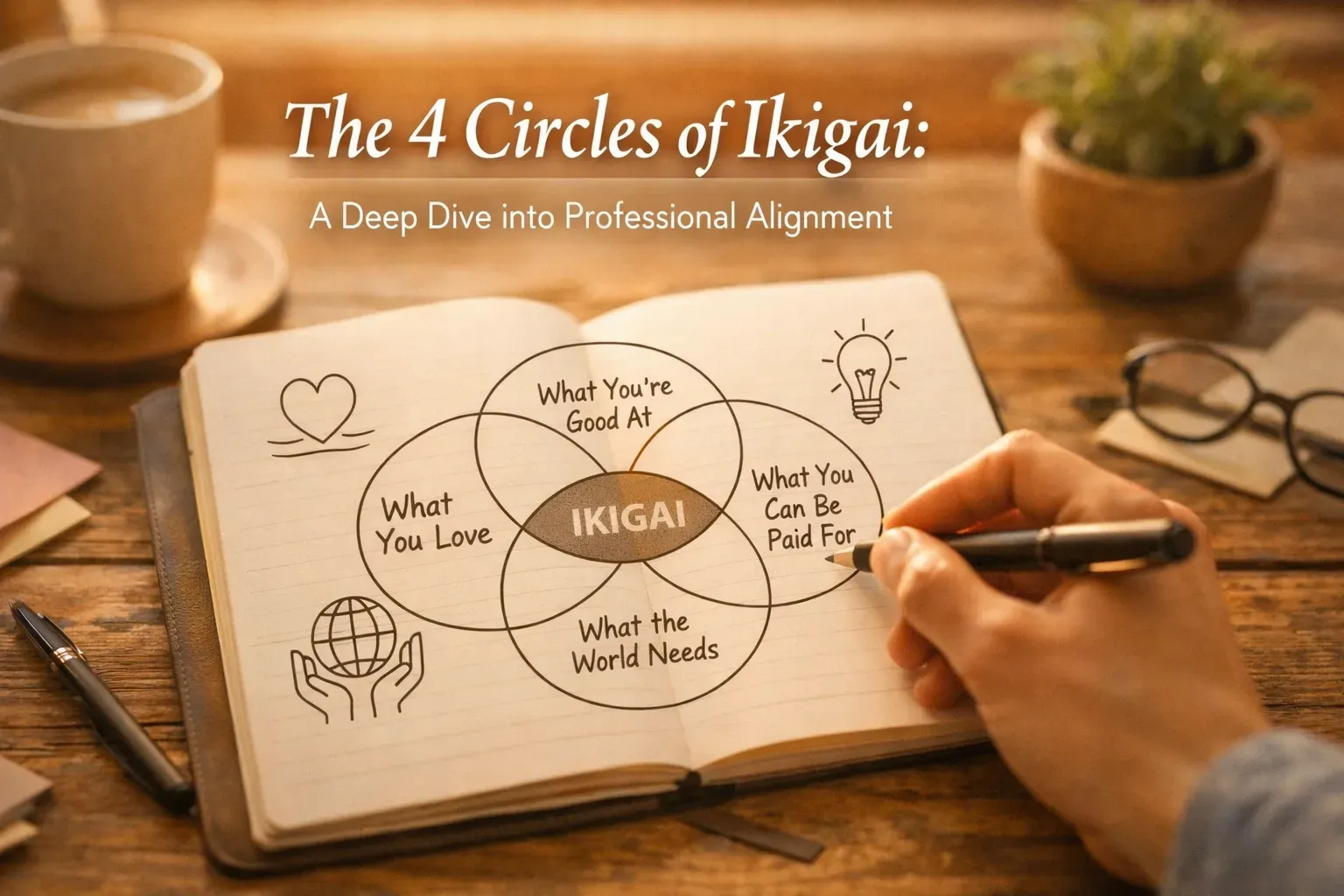
The 4 Circles of Ikigai: A Deep Dive into Professional Alignment
"Alignment isn't a destination where you suddenly stop, it's the harmony of your inner parts finally finding a common purpose in the world."
Welcome back to our series on Ikigai. In our first post, we touched on the Japanese concept of "a reason for being." But if you’re like most of the high-achieving professionals I work with here in New Hampshire, you don’t just want a definition, you want a map. You want to know why, despite having a great job on paper, you wake up feeling like something is missing.
Professional alignment is the sweet spot where your internal world meets the external marketplace. It’s where your soul says "yes" and your bank account doesn't say "no." To get there, we have to look at the four circles of the Ikigai framework and, more importantly, what happens in the spaces where they overlap. Let's take a look at the architecture of a fulfilled life.
The four pillars of your professional life
Before we can find the center, we have to understand the boundaries. The Ikigai model is composed of four primary circles. Think of these as the "North Stars" of your career:
- What you love (passion): These are the activities that make time disappear. It’s the work that energizes you rather than draining you.
- What you’re good at (vocation): This is your zone of genius. It includes your learned skills, your natural strengths, and the things people always ask for your help with.
- What the world needs (mission): This is your contribution. It’s the service you provide that solves a problem or fills a gap in society, whether that’s at a local community level or a global scale.
- What you can be paid for (profession): This is the practical reality. It’s the marketplace demand that allows you to sustain your lifestyle and create financial freedom.
When all four of these are in balance, you’ve found your Ikigai. But for most of us, the reality is a bit more lopsided. We usually have two or three circles working well, while one is trailing behind.

The intersections and where we get stuck
The magic (and the frustration) happens in the intersections. When you have some circles but not others, you experience specific flavors of dissatisfaction. Mapping where you are right now is the first step.
Here are the most common stuck points I see in coaching:
- The passionate but broke: You are doing what you love, you’re great at it, and it helps people, but you haven't figured out the "Paid For" part. This often leads to The Starving Artist syndrome. You feel fulfilled but constantly stressed about survival.
- The golden handcuffs: You’re talented, the world needs your work, and the pay is fantastic. But... you don't love it. This is the classic corporate burnout. You feel comfortable, but there’s a sense of emptiness or "is this all there is?"
- The bored expert: You’re doing what you love, you’re getting paid, and you’re a pro. However, it doesn't feel like it matters to the world. You might feel a sense of uselessness or a lack of legacy.
- The high-stakes mission: You love the cause, the world needs it, and you're paid, but you aren't actually that good at the specific tasks required. This leads to high anxiety and a constant fear of being found out (hello, imposter syndrome!).
Do any of these resonate with you? Be gentle with yourself as you identify these gaps. It’s not a sign of failure, it’s simply a sign that your map needs updating.
The IFS perspective: Who is running your circles?
At Ananda Experience, we look at professional alignment through the lens of Internal Family Systems (IFS). If you’re new to this, you can check out my guide to Internal Family Systems and understanding your parts.
In the context of Ikigai, different "parts" of you often value different circles. This is why you feel so conflicted!
- The manager part: This part is usually obsessed with the "What You Can Be Paid For" circle. It wants security, status, and a 401k. It might push you to stay in a soul-crushing job because it’s terrified of financial instability.
- The firefighter part: This part might react when you’re bored or unfulfilled by pushing you toward "What You Love" in impulsive ways: like quitting a job suddenly or spending money on hobbies to feel alive again.
- The exile: This part often holds your deepest passions. It might have been told long ago that art doesn't pay the bills, so it’s been tucked away, leaving you feeling dimmed.
- The people-pleaser: This part is hyper-focused on "What the World Needs," often at the expense of what you love or what you're actually good at.
When we practice Self-leadership, we don't let the manager or the people-pleaser drive the bus. Instead, we listen to all these parts and lead from a place of Self: the calm, creative, and courageous core of who you are. From this space, you can negotiate a career path that honors your need for security and your need for meaning.

Mapping your own experience
Ready to do some parts work on your career? Here are some simple ways to start mapping your alignment today:
- Audit your calendar: Look at your last work week. Which tasks fell into "What I Love"? Which were just "What I'm Paid For"?
- Identify your skills: Make a list of things you’re good at, but separate them into "Skills I love using" and "Skills I’m tired of using." Just because you’re good at something doesn't mean it has to be part of your Ikigai.
- Listen to the conflict: When you think about making a change, what do the different voices in your head say? Write them down. "I can't quit because of the mortgage" (the manager). "I just want to do something that matters" (the visionary).
- Check your nervous system: How does your body feel when you engage with each circle? True alignment usually feels like a settling in the nervous system. If you want to dive deeper into this, our guide to practicing mindfulness daily can help you tune into those physical cues.
Moving toward the center
Finding your Ikigai isn't about blowing up your life and starting over from scratch (though sometimes a pivot is exactly what’s needed!). Often, it’s about making micro-adjustments to bring your circles closer together.
Perhaps you stay in your current profession but look for ways to pivot your role toward doing what you love. Or maybe you take those skills you’re good at and apply them to a new mission that the world desperately needs right now.
Remember, you have the internal resources to navigate this. You are not stuck, you are simply in a process of refinement. Trust that you can hold the tension of these four circles until they start to hum in harmony.
In our next and final post of this series, we’ll talk about the 'how': the practical steps to transitioning into your Ikigai without losing your mind (or your shirt) in the process.
Your action step for today: Pick one circle that feels the most empty right now. Don't try to fix it yet: just notice it. Say to that part of you, "I see that we’re missing some joy/security/purpose here, and I’m going to help us find it."
You’ve got this. The path to a great life is paved with these small moments of honest awareness. If you're feeling the pull to dive deeper into your personal development, start with a quiz.
Articles