Ikigai: Finding Your Reason for Being in the Corporate Chaos
"True fulfillment isn’t a destination you reach after a twenty-year climb up the corporate ladder. It’s the harmony you create when your daily actions align with your deepest 'why.' "

If you’ve spent any time commuting down I-93 or sitting in a high-rise office in Manchester, you know the feeling. You’ve hit the milestones. You have the title, the salary, and perhaps the beautiful home near the Lakes Region. Yet, on a Tuesday morning at 10:00 AM, looking at a spreadsheet or sitting in your third back-to-back Zoom call, a quiet voice inside asks: Is this it?
You aren't alone. Many of the high-achieving professionals I work with here in New Hampshire find themselves in this exact spot: successful by every external measure, but internally, they feel a bit like they’re running on a treadmill that’s powered by someone else’s dreams.
I believe that your professional life shouldn't be a sacrifice of your personal joy. That’s why I want to introduce you to a concept that has transformed the way I view work, life, and leadership: Ikigai.
What is Ikigai?
Ikigai (pronounced ee-key-guy) is a beautiful Japanese philosophy that translates roughly to "a reason for being." It comes from the words iki, meaning "life," and gai, meaning "value" or "worth." Think of it as your reason to get up in the morning.
In Western culture, we often separate our lives into rigid boxes: Work (where we make money), Hobby (where we have fun), and Service (where we give back). Ikigai challenges this separation. It suggests that a truly meaningful life happens at the intersection of our passions, our talents, our survival needs, and our contributions to society.
It isn't just about finding a dream job. It’s a state of well-being that arises from devotion to activities you enjoy, which also bring a sense of fulfillment and purpose. It’s about finding that sweet spot where you feel fully alive and Self-led, a term we use often in
Internal Family Systems (IFS) coaching.

The four pillars of Ikigai
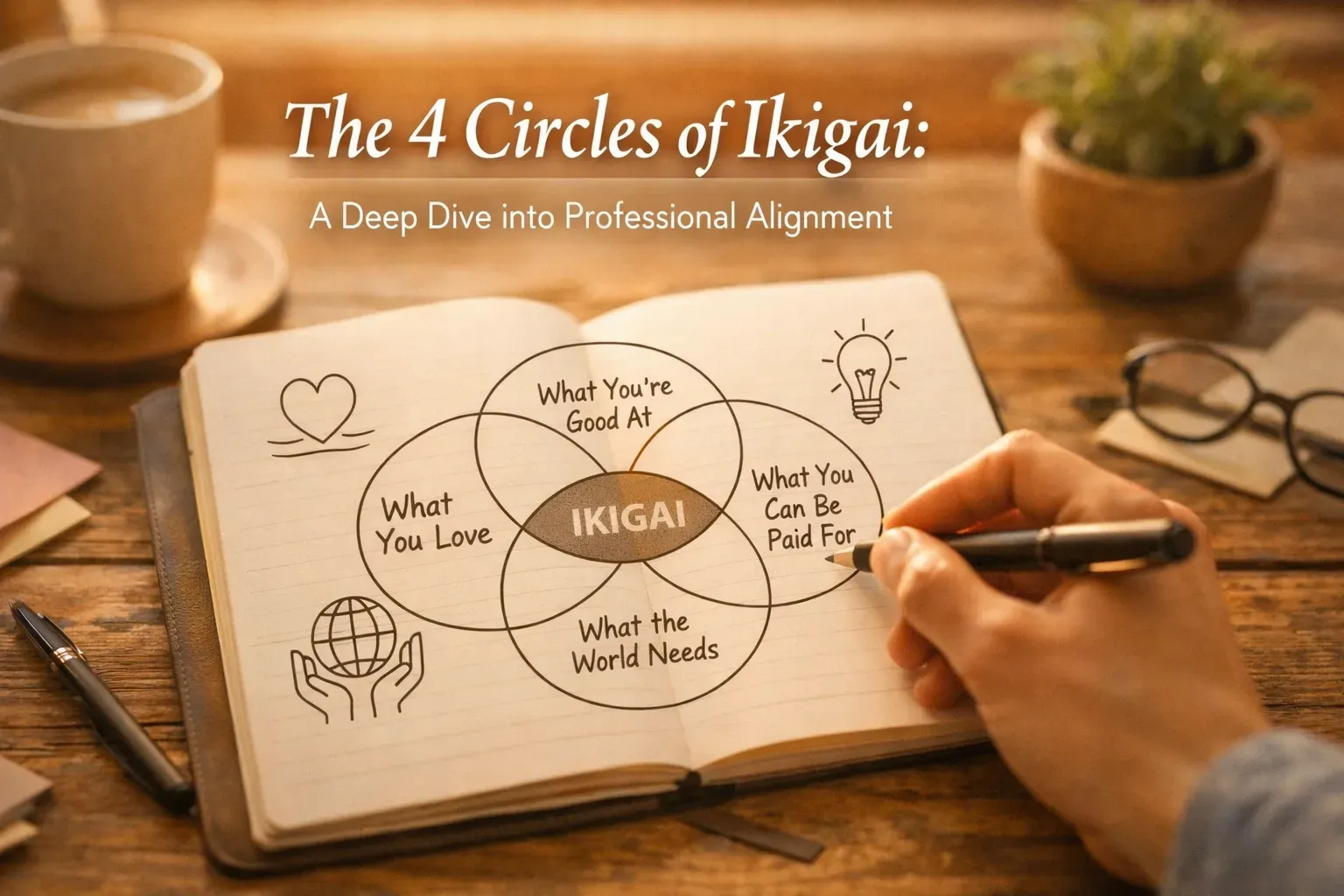
To find your Ikigai, we look at the intersection of four distinct circles. Imagine a Venn diagram where your life’s potential is waiting right in the middle. Let’s take a look at these four pillars and how they might show up for you right now in the corporate world.
1. What you love (passion)
This is the spark. It’s the work that makes you lose track of time. Maybe it’s the creative problem-solving sessions, the way you feel when you’re mentoring a junior colleague, or even the deep focus of strategic planning.
Ask yourself: If money weren't an issue, which parts of your current job would you still do for free?
2. What you are good at (vocation)
These are your strengths, both the ones on your resume and the soft skills that make you who you are. Maybe you’re an incredible negotiator, a gifted public speaker, or someone who can calm a room full of stressed-out executives just by walking in.
Ask yourself: What do people consistently come to you for? What feels easy to you but seems difficult for others?
3. What the world needs (mission)
In the corporate chaos, it’s easy to feel like you’re just a cog in a machine. But every business exists to solve a problem. Whether you’re in tech, healthcare, or finance, your work impacts people.
Ask yourself: What problems in your industry or community keep you up at night? How does your unique presence make your workplace or the world a better place?
4. What you can be paid for (profession)
We live in the real world. You have a mortgage, family needs, and perhaps a retirement plan to consider. This circle is about sustainability. Your Ikigai must support your life.
Ask yourself: Which of your skills are currently in high demand? How can you leverage your expertise to create the financial freedom you desire?
Why corporate success often feels empty
For many of us in our 30s, 40s, and 50s, we’ve spent years focusing heavily on the "What you can be paid for" and "What you are good at" circles. This is the successful professional zone.
You’re competent and you’re compensated, but if you’re missing "What you love" and "What the world needs," you end up feeling a sense of emptiness. You might feel useful, but you don't feel inspired. On the flip side, if you focus only on what you love and what the world needs, you might have plenty of "Mission" but no "Profession," leading to financial stress and burnout.
The goal of our work at
Ananda Experience is to help you gently shift your focus so these circles start to overlap more consistently.

Ikigai and your "parts"
As an IFS coach, I look at Ikigai a little differently. I see these four circles not just as external categories, but as internal voices.
You might have a manager part of you that is hyper-focused on the "Paid For" circle. This part wants security and status. You might also have a dreamer part that is starving for the "What You Love" circle. Often, these parts are at war, which is why you feel stuck.
When we practice inner work, we help these parts talk to each other. We use Self-leadership to acknowledge the need for financial security while also honoring the soul’s need for purpose.
Here are some simple ways to start identifying your Ikigai today:
- Audit your calendar: For one week, mark every task with a symbol for the four circles. See where the imbalances are.
- Identify your zone of genius: Notice when you feel in the flow. What were you doing? Who were you with?
- Practice patience: Finding your Ikigai is a journey, not a weekend workshop. Be gentle with yourself as you explore these questions.
- Listen to your body: Your nervous system often knows your Ikigai before your brain does. Pay attention to when you feel expansive and when you feel constricted.
Bringing it home to the Granite State
Whether you're grabbing a coffee in downtown Concord or taking a weekend hike up Mount Major, I want you to carry this concept with you. Your reason for being isn't something you have to invent, it’s something you uncover.
It’s about peeling back the layers of corporate expectations and 'shoulds' to find the vibrant, purposeful person who has been there all along. You have the power to create a career that feels as good on the inside as it looks on paper.
In the next part of this series, we’re going to dive deeper into the first two circles: Passion and Vocation. We’ll look at how to rediscover what you actually love doing after years of doing what was expected of you.
For now, take a deep breath. You are exactly where you need to be to begin this transition. Your Ikigai is waiting for you to notice it.
Articles