Navigating the Fear of Leaving a High-Status Role
"True wealth is the ability to live life on your own terms, where your daily actions are a mirror of your deepest values."

You’ve reached the top. You have the impressive job title, the corner office (or the high-end home office), the stock options, and the kind of salary that makes people say, "You’ve made it." But lately, when you wake up, there’s a heavy sensation in your chest. You look at your calendar and feel a sense of dread instead of excitement.
You’re experiencing the "golden handcuffs" dilemma. It’s that paralyzing state where your financial rewards are so high that leaving feels like financial suicide, yet staying feels like a slow erosion of your soul.
Professional success shouldn't come at the cost of your internal peace. Let’s explore how you can get out of those handcuffs without crashing your life, using the wisdom of Internal Family Systems (IFS) and the concept of Ikigai.
Understanding the trap
The term golden handcuffs refers to the financial incentives: high salaries, deferred bonuses, or unvested stock options that lock you into a role. While they are designed by companies to retain talent, they often become a psychological cage. You might find yourself saying:
- "I can’t leave until my options vest in two years."
- "No one else will pay me this much for what I do."
- "I’ve built a lifestyle that requires this exact income."
This isn't just a financial situation, it's a conflict of values. When your external rewards no longer align with your internal purpose, you begin to experience burnout, chronic stress, and a loss of identity.
The IFS perspective
In Internal Family Systems (IFS), we look at your hesitation not as a weakness, but as a collection of parts trying to protect you. When you think about quitting, several parts of your internal system likely go into high alert.
1. The financial manager
This part is responsible for your survival. It looks at your mortgage, your kids’ tuition, and your retirement fund. When you mention leaving your high-status role, the financial manager screams, "Danger!" It views any pay cut as a threat to your safety.
2. The prestige seeker
This part enjoys the status of your role. It likes the way people react when you tell them your job title. To this part, leaving the role feels like losing your identity. It asks, "Who will you be if you aren't a Senior VP?"
3. The perfectionist
This part wants to ensure you never make a mistake. It views leaving a good job as a failure or a reckless move. It keeps you stuck by demanding a 100% guaranteed plan before you take a single step.
Gently bring your attention to these parts. They aren't trying to make you miserable, they are trying to keep you safe. By acknowledging them, you can start a dialogue rather than being driven by their fear. For a deeper dive into this framework, check out my
guide to Internal Family Systems.

Re-framing the exit as a transition, not a cliff
One of the biggest mistakes leaders make is viewing the departure from a high-status role as a jump off a cliff. This all-or-nothing thinking triggers your safety parts and keeps you frozen. Instead, let's look at this as a conscious transition. Here are some simple ways to shift your mindset:
- View it as a pivot: You aren't throwing away your career, you are taking the skills and wisdom you’ve gained and applying them to a more aligned container.
- The bridge strategy: Instead of quitting tomorrow, create a 12-to-18-month plan. This gives your financial manager part time to relax as you build a safety net.
- Micro-experiments: Start engaging in the work you actually want to do on a small scale. This builds confidence and proves to your system that there is life beyond the current role.
Using Ikigai to find your north star
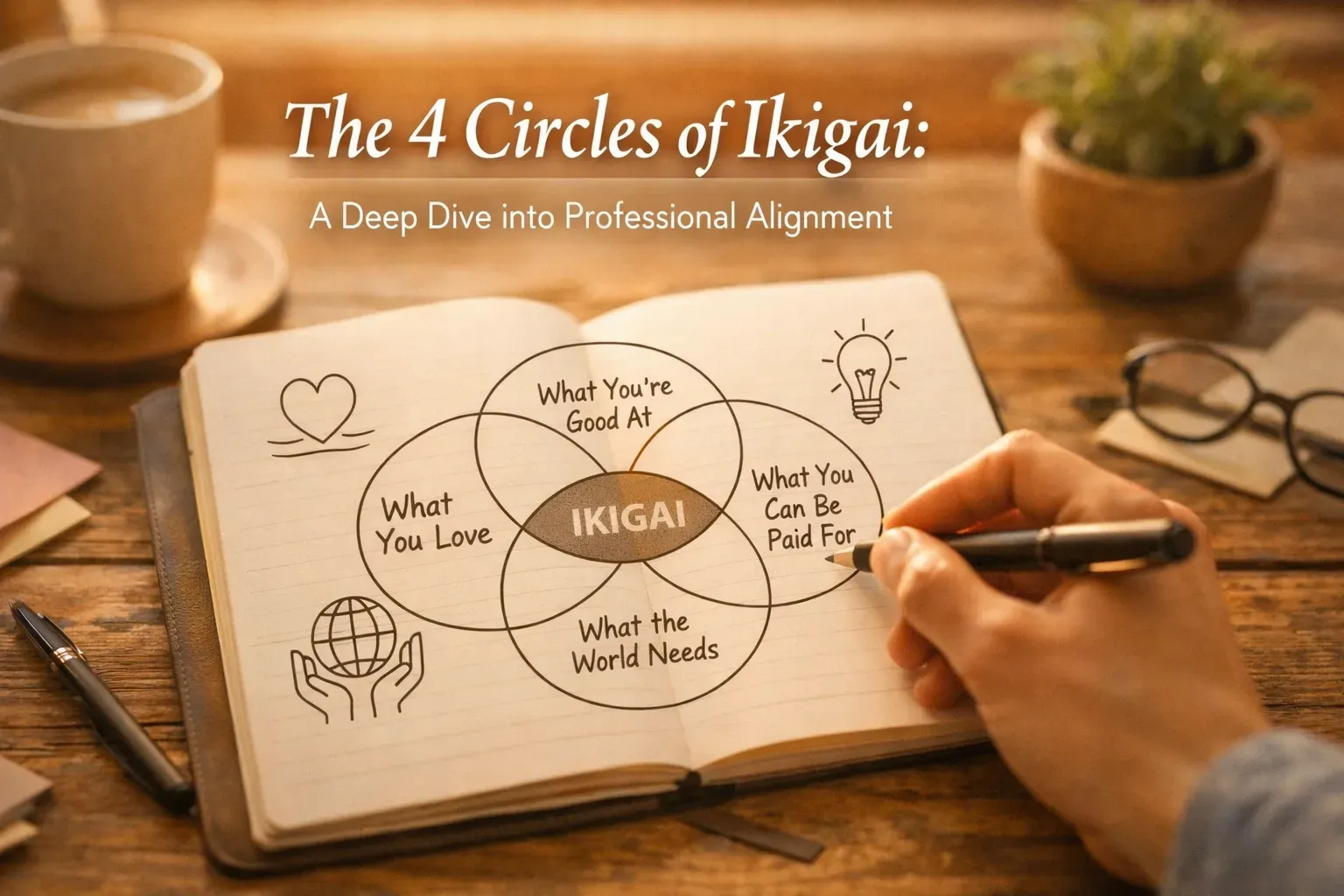
If you’re going to leave the security of the golden handcuffs, you need a compelling 'why'. This is where the Japanese concept of Ikigai (your reason for being) comes in. To find your alignment, you need to look at the intersection of:
- What you love.
- What you are good at.
- What the world needs.
- What you can be paid for.
Often, in high-status roles, we are heavily weighted in what we are good at and what we can be paid for, but the what we love and what the world needs circles are empty. Transitioning is about bringing those four circles back into balance.

Steps to break free
If you’re feeling the weight of the handcuffs today, here is a practical roadmap to start your journey toward freedom:
1. Audit your true needs
Sit down and look at your actual expenses versus your lifestyle inflations. How much of your spending is a result of stress-relief from the job you hate? You might find that you need significantly less than you think to live a joyful, fulfilled life.
2. Negotiate with your parts
Instead of pushing the fear away, try this: Sit quietly, breathe, and ask your financial manager part, "What are you afraid would happen if we left?" Listen to the answer without judgment. Then ask, "What would you need to see in place to feel safe enough to let me explore a change?"
3. Update your value proposition
You are more than your current title. Create a list of your transferable skills that stay with you regardless of the company name on your business card. This helps the prestige seeker realize that your value is internal, not external.
4. Build your transition fund
Start redirecting your bonuses or extra income into a specific freedom fund. Having a tangible financial cushion is the fastest way to quiet the safety parts and allow your visionary Self to lead.
5. Seek dupport
Transitioning is hard to do alone. Connect with a coach or a community that understands the nuances of high-level transitions. You can meet Julia to see how she support leaders through these exact shifts.
Practicing patience throughout the process
Breaking free from golden handcuffs is rarely an overnight event. It requires a lot of Self-led patience. Be gentle with yourself as you navigate the back-and-forth between your desire for freedom and your need for security. It is normal to feel brave one day and terrified the next.
Remember the lessons we can take from nature. Just as the seasons change slowly and intentionally, your life transition can be a gradual unfolding. I talk more about this in our article on patience as a conscious practice.

Your life is the ultimate ROI
At the end of the day, the most valuable asset you have is your time and your energy. No bonus or title can compensate for a life spent in misalignment. By approaching your golden handcuffs with curiosity, compassion, and a strategic plan, you can move toward a career that doesn't just pay the bills, but actually feeds your soul.
You have the power to redefine what success looks like. You aren't just leaving a job, you are stepping into a more authentic version of yourself.
Articles